
NEWS
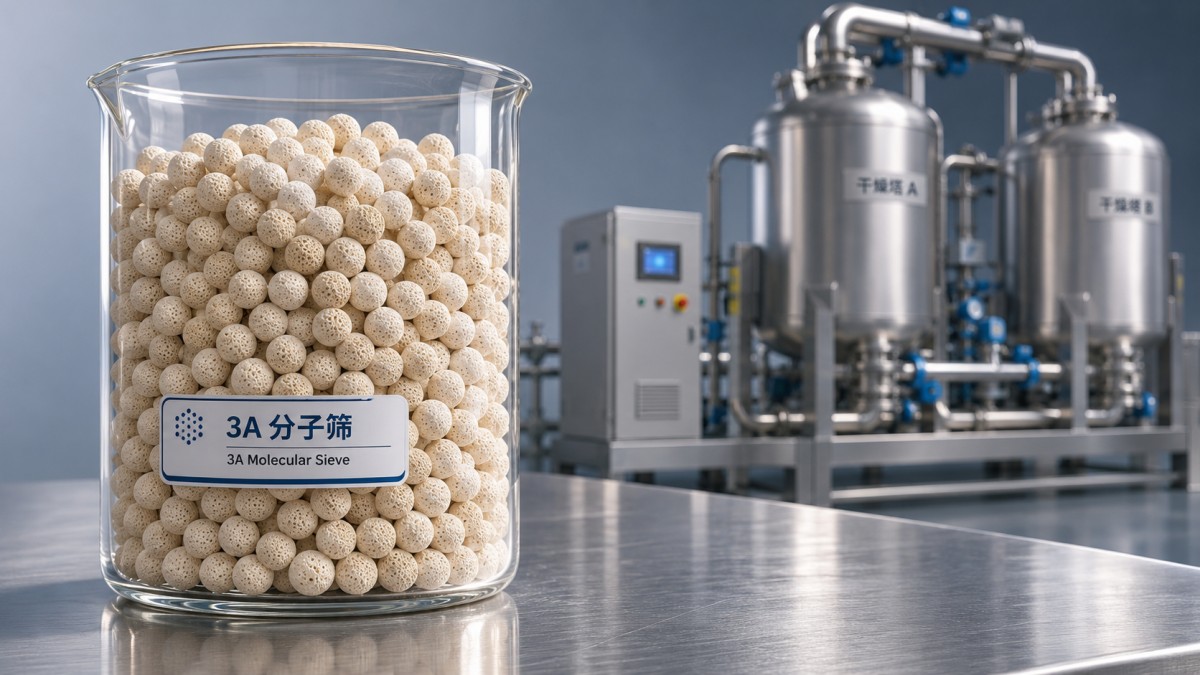
Molecular Seive 3A, more commonly spelled molecular sieve 3A, is a synthetic zeolite desiccant used to remove water from gases and liquids. Its approximately 3-angstrom pore openings allow it to adsorb water molecules while excluding many larger molecules, making it useful in applications such as ethanol dehydration and insulating glass production. Understanding its properties, applications, and operating requirements can help you select the right drying solution for your process.
The defining advantage of 3A is not simply that it attracts moisture. Many materials do that. Its value is that it can remove water while limiting the entry of certain other molecules into its pores. That selectivity matters when the surrounding gas or liquid is the product you want to preserve, recover, or keep out of the adsorption bed.
What the 3A designation means in practice
A 3A molecular sieve is generally produced by exchanging potassium ions into a type A zeolite. The resulting effective pore opening is approximately 3 angstroms. Water molecules are small enough to enter and are strongly attracted to sites inside the crystalline structure. Many larger molecules are excluded, although actual behavior depends on molecular shape, operating conditions, and the specific adsorbent.
The pore-size figure should be treated as a useful selection guide, not as a perfectly sharp molecular ruler. A molecule’s effective size can vary with its orientation, and access to the pores is influenced by diffusion and temperature. If retaining a particular component is critical, ask for relevant mixture data or arrange a trial rather than relying on molecular diameter alone.
Commercial material is commonly supplied as beads or extrudates. These are engineered particles containing zeolite crystals and, depending on the product, a binder. Particle shape and size affect pressure drop, mechanical strength, loading behavior, and the rate at which water reaches the adsorption sites. Two products labeled 3A can therefore perform differently in the same vessel.
Adsorption also differs from absorption: water is held on internal surfaces rather than simply soaking into the material as it would into a sponge. That distinction helps explain why a sieve can be regenerated by driving water off, but it does not mean the material can be reused indefinitely or restored by any heating method.
Where 3A earns its place in a chemical process
Drying ethanol without relying on ordinary distillation alone
Ethanol and water form an azeotrope at atmospheric pressure, which limits the purity achievable by conventional distillation under those conditions. Molecular sieve dehydration offers another separation step: water enters the 3A pores much more readily than ethanol, allowing the ethanol stream to be dried further.
In an industrial unit, the sieve is only one part of the design. Feed composition, vapor or liquid phase, pressure, temperature, and the required final water content all affect the bed and cycle. Vapor-phase systems may use alternating beds so that one adsorbs while another is regenerated, but the configuration must fit the plant’s heat supply, pressure conditions, and recovery requirements.
A frequent mistake is to size the adsorber around average inlet moisture and ignore the wettest expected feed. If upstream distillation or condensation becomes unstable, the water load can rise and the outlet may go off specification before the scheduled switch. An inlet moisture measurement and a realistic upset allowance are often more valuable than a larger vessel chosen without a proper mass balance.
Moisture control in sensitive gas streams
Type 3A is also considered for drying certain unsaturated hydrocarbon streams, where adsorption of larger process molecules is undesirable. Selectivity can help reduce unwanted uptake compared with a larger-pore sieve. It is not, however, a substitute for checking the stream’s full chemistry: contaminants, reactive compounds, heavy components, and liquid carryover can still affect bed life or safe operation.
For instrument or utility gas, the choice may be less straightforward. If water is the only concern, 3A can be appropriate. If carbon dioxide, sulfur compounds, or other contaminants also need to be removed, a different adsorbent or a staged bed may be required. The right question is not “Which sieve is strongest?” but “What must leave the stream, and what must remain?”
Insulating glass is a different kind of drying job
In insulating glass units, desiccant is typically held in the spacer system to capture residual moisture within the sealed cavity. Here, the operating objective is long-term moisture control rather than a regenerable process cycle. The material, spacer, sealants, filling process, and storage conditions all contribute to performance.
A glass-grade product should be assessed for the intended unit design rather than selected solely because it carries a 3A label. Particle size, dust, compatibility with the filling equipment, and behavior with the cavity gas are relevant. Once the package is opened, excessive exposure to workshop air consumes part of the desiccant’s useful capacity before the unit is sealed.
3A, 4A, 5A, or silica gel: the choice depends on the stream
The number in a molecular sieve designation refers approximately to its effective pore opening. A larger opening can admit molecules that 3A excludes, which may be useful for separating additional components but undesirable when preserving a product stream. Silica gel works differently: it is an amorphous silica adsorbent rather than a crystalline zeolite with the same type of uniform molecular-sized pore openings.
Molecular sieves are often chosen when very low residual moisture is required, while silica gel can be practical for controlling humidity in enclosed packages. Neither is automatically better for every duty. Performance must be compared at the actual temperature, water concentration, contact time, and endpoint—not against an isolated maximum-capacity figure.
The specification that matters is working capacity
A supplier’s data sheet may report water capacity under a defined test condition. That number is useful for comparing material quality, but it is not necessarily the capacity available between regeneration and the moment the outlet exceeds its moisture limit. A production bed needs a margin for the mass-transfer zone, uneven flow, aging, and variations in the feed.
Consider a dryer that must deliver a very dry outlet. Water begins to accumulate at the inlet end, creating a zone that moves through the bed. The outlet can remain dry for much of the cycle and then rise as that zone approaches the downstream end. This rise is called breakthrough. If the acceptable outlet limit is extremely low, the useful cycle may end well before the bed reaches its overall equilibrium capacity.
For a meaningful selection discussion, provide the supplier with more than flow rate. The following information usually changes the answer:
- Feed composition, phase, operating pressure, temperature, and normal and maximum flow.
- Inlet water concentration, including likely peaks and any possibility of liquid droplets.
- Required outlet moisture limit and how it will be measured.
- Desired operating time between bed switches or replacement.
- Available regeneration gas, temperature, pressure, and cooling arrangements.
- Allowable pressure drop, vessel dimensions, and restrictions on dust or product loss.
Units deserve attention. Water content may be specified by mass, volume, dew point, or another basis, and these are not interchangeable without the relevant conditions. A supplier and plant team can appear to agree on a target while designing for different measurements. Put the basis, sampling point, and operating pressure in writing.
Particle size is another trade-off. Smaller particles can shorten the diffusion path, but they can also increase pressure drop and create more concern about fines. Larger particles may ease flow resistance but need sufficient contact time. Bed dimensions and distributor design should be considered alongside the particle, especially when a vessel is being retrofitted rather than designed from scratch.
Regeneration is a process step, not a reset button
Many industrial 3A beds are regenerated with a heated, dry purge gas, sometimes as part of a pressure-swing or temperature-swing arrangement. Heating shifts the balance so adsorbed water can leave the sieve; the purge carries it out of the vessel. The bed is then cooled under suitable dry conditions before returning to service. Actual temperatures, flow rates, duration, and sequencing must follow the adsorbent and equipment suppliers’ recommendations for the application.
The outlet temperature alone does not prove that the whole bed is regenerated. Heat must penetrate the vessel, and water must have time to move out of the particles and be carried away. Conversely, heating longer than necessary wastes energy and can expose equipment or adsorbent to avoidable stress. Monitoring regeneration gas temperature and, where practical, moisture at the outlet gives a more useful picture than relying on a timer alone.
Cooling deserves just as much attention. If a bed is exposed to humid air while hot or during standby, it can start loading water before the next adsorption cycle. Switching a hot bed directly into service can also affect outlet conditions and equipment performance. Confirm that the cooling medium is sufficiently dry and compatible with the process.
Regeneration cannot reliably remove every contaminant. Oils, heavy organic compounds, solids, or degradation products may foul a bed and reduce its usable life. The remedy may be better upstream filtration, liquid separation, or a guard bed—not a more aggressive heating schedule. Disposal or replacement should follow the site’s waste assessment, since a used adsorbent may contain substances captured from the process.
Troubleshooting a bed that breaks through early
When outlet moisture rises sooner than expected, replacing the adsorbent may solve the symptom without finding the cause. Start by checking whether the analyzer and sampling system are representative: leaks, contaminated sample lines, or an incorrect pressure basis can produce misleading readings.
Next, compare the actual water load and flow with the design case. A failed upstream separator can send liquid into a bed intended for vapor drying; an upstream temperature change can alter the amount of water entering the vessel. Both can consume capacity much faster than a routine operating log suggests.
If inlet conditions are stable, investigate regeneration and flow distribution. Inadequate purge, insufficient heating or cooling, damaged internals, settling, or channeling can leave part of the bed underused. A rising pressure drop may point toward fouling or particle breakdown, although it does not identify the cause on its own. Reviewing moisture trends together with pressure, temperature, and switch timing is generally more informative than looking at any one reading.
New material also needs protection. Keep containers sealed until loading, minimize exposure to ambient air, and use the supplier’s instructions for handling and commissioning. Do not assume that a drum opened during maintenance and left unsealed is still in the same condition as unopened stock.
When the moisture problem is inside a package
Not every drying problem calls for a molecular sieve vessel. Shoes in a shipping carton, a camera in protective packaging, or metal components held in a sealed bag face a different moisture load from an ethanol dehydration unit. For these applications, a silica gel sachet can be a more practical humidity-control option, provided the package has an adequate moisture barrier and the desiccant quantity is matched to the enclosure and expected storage conditions.
The Silicone desiccant pack contains amorphous silica gel rather than silicone polymer or 3A zeolite. Options include custom fill weights from 0.5 g to 1,000 g and breathable wrapping materials such as Tyvek or non-woven fabric. For electronics, retail goods, or diagnostic products, check the sachet’s dust containment, packaging compatibility, and relevant documentation for the specific use. A desiccant pack cannot compensate indefinitely for packaging that allows moisture to enter continuously.
Can't find what you're looking for ?
Leave a Message we will call you back quickly!
Get in Touch
*We respect your confidentiality and all information are protected.