
NEWS
A gamma alumina catalyst support needs pores large enough to admit reactants and release products, but not so large that it sacrifices the surface area needed to disperse the active phase. The best pore size therefore depends on the molecules entering the catalyst, the reaction conditions, and how the pore structure changes during preparation and operation.
A single average pore diameter rarely tells the whole story. Two supports with similar averages can have very different proportions of narrow pores, transport channels, and accessible surface area. For a meaningful comparison, examine pore size distribution alongside pore volume, surface area, particle size, and the properties of the finished catalyst.
What pore size controls inside a catalyst particle
In a porous catalyst, reactants travel from the bulk gas or liquid to the outside of a particle and then through its internal pore network. They reach active sites on the pore walls, react, and diffuse back out as products. Pore size affects this internal journey as well as the amount and location of surface available for active components.
When transport through the pores is fast relative to the reaction, a larger fraction of the internal active sites can contribute. When transport is slow, reactants may be consumed near the particle exterior before reaching the center. The catalyst can then contain substantial active material that contributes little under operating conditions.
This distinction matters when comparing activity. A support with more surface area may help disperse a metal or other active phase, but that advantage can be reduced if much of the surface is difficult for the reacting molecules to reach. Conversely, a more open structure may improve access while providing less area per unit mass for dispersion.
Internal diffusion can also affect selectivity. If a desired intermediate remains inside the particle for too long, it may undergo further reactions before escaping. Wider or better-connected pathways can sometimes reduce that residence time, although the outcome also depends on reaction kinetics, adsorption, and the active-phase distribution.
Mesopores and macropores play different roles
Pores are commonly grouped by diameter: micropores are smaller than 2 nm, mesopores are 2–50 nm, and macropores are larger than 50 nm. These categories are useful for describing pore architecture, but the boundaries do not determine performance on their own.
Gamma alumina supports often rely on mesopores to provide substantial surface area for active-phase deposition. Their effectiveness depends on whether the relevant reactants and products can move through those pores under process conditions. A mesopore that is accessible to a small gas molecule may be restrictive for a bulky liquid-phase species or for a molecule surrounded by a solvent shell.
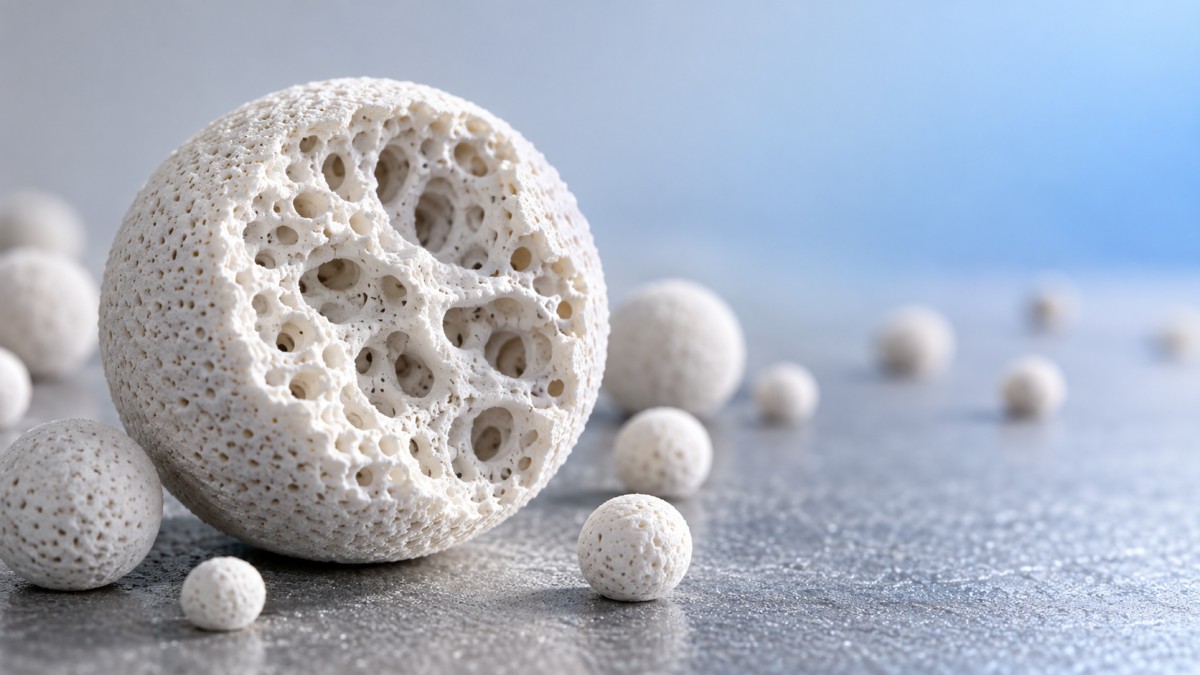
Macropores can provide wider pathways into the particle. In a bimodal structure, these larger channels are combined with smaller pores that supply much of the surface area. This arrangement can be useful when transport into the particle is a concern, particularly for feeds containing larger molecules or species that deposit during operation.
However, adding macropore volume is not automatically beneficial. At a given particle size, more large-void volume can reduce the material available to provide surface area or mechanical strength. The balance depends on how the support is formed and on how well the larger channels connect to the smaller pores. A large pore that does not provide access to useful active surface contributes less than its volume alone might suggest.
Why average pore diameter can be misleading
Average pore diameter is a useful screening value, not a complete description of a support. Some reported averages are calculated from total pore volume and BET surface area using a simplified pore geometry. Others come from a particular region of a measured pore size distribution. These values should not be treated as interchangeable without understanding how they were obtained.
Consider two nominally similar supports. One may have a relatively narrow distribution centered around its reported average. The other may combine many small pores with a smaller volume of much larger pores. Their averages could be close, while their accessibility, surface area distribution, and response to fouling differ substantially.
Pore shape matters as well. A wide internal cavity connected to the particle exterior through a narrow neck can behave, from a transport perspective, more like a narrow-pore system. Conversely, a connected network of larger channels can improve access even when much of the surface is associated with smaller pores. Tortuosity, connectivity, and the location of bottlenecks are not captured by an average diameter.
For comparisons, request the pore size distribution or the underlying adsorption and intrusion data where relevant. Look at the fraction of pore volume in the size range that matters to the feed, not just the highest point on a distribution curve. Also distinguish a distribution reported by pore volume from one reported by surface area: large pores can account for substantial volume without contributing the same proportion of total area.
Match pore architecture to the feed and reaction
Small molecules and relatively clean feeds
When reactants and products are small and the feed contains little material likely to block pores, a mesoporous support with high accessible surface area may be a sensible starting point. The extra area can help disperse the active phase, provided the selected pore network remains accessible after catalyst manufacture.
Even in a clean gas-phase reaction, diffusion should not be dismissed solely because the molecules are small. High intrinsic reaction rates, larger particles, or a strongly adsorbing species can create concentration differences within the catalyst. A support that performs well at one temperature, pressure, or particle size may show a different utilization pattern when those conditions change.
Bulky molecules and liquid-phase reactions
For larger reactants, accessibility becomes more demanding. Molecular dimensions are a starting point, but they are not the only constraint: molecule shape, solvent interactions, adsorption, and pore-neck geometry also influence transport. A pore diameter only slightly larger than an estimated molecular dimension may not provide the mobility needed for an effective reaction rate.
In liquid-phase systems, diffusion within pores can be slow enough to limit the benefit of a highly active formulation. A broader pore network or a support with larger transport channels may improve access, but the choice should be evaluated with the actual solvent and concentration range. The liquid can affect both diffusion and adsorption, so a pore structure selected using gas-phase assumptions may not rank the same way in service.
Heavy feeds and deposition-prone service
In heavy oil processing, large molecules and deposit-forming components make pore accessibility a central concern. Metals, carbonaceous deposits, and other accumulated material can reduce pore openings over time. When narrow entrances become blocked, the surface behind them can become inaccessible even if the interior has not been fully covered.
Larger transport pores may delay this loss of access in some duties and help bulky species reach internal sites. They do not eliminate fouling, and they are not necessarily the best choice for every reaction in a heavy-feed process. Feed composition, catalyst grading, operating severity, and the desired conversion all affect whether additional macroporosity is worth a potential reduction in surface area or strength.
Pore size changes when the catalyst is made
A pore specification for fresh alumina describes the support before active components are added. Impregnation, drying, calcination, and subsequent activation can change the accessible pore structure. Deposited material occupies pore volume and may narrow pore entrances; uneven deposition can leave some regions heavily loaded while others remain underused.
The relationship between initial pore size and final accessibility is therefore not always straightforward. A support with very high initial surface area may lose a significant part of its usable pore network if the chosen loading or preparation method concentrates material in narrow passages. A more open support may accommodate a formulation differently, although it can also produce a different metal dispersion or distribution.
Ask for both support and finished-catalyst characterization when the decision is consequential. Compare surface area, pore volume, and pore size distribution after preparation, using consistent test methods. Where possible, connect these measurements to activity and selectivity under relevant conditions. A lower measured pore volume after loading is expected, but the operational question is whether enough connected pore space and accessible active surface remain.
Impregnation behavior also depends on solution chemistry, wetting, drying rate, and interactions between the precursor and alumina. Pore diameter alone cannot predict where an active component will end up. For example, a formulation intended to place active material near the outer region of a particle has different requirements from one intended to distribute it throughout the pellet.
Particle size, pressure drop, and pore size are separate decisions
Reducing particle diameter shortens the distance reactants must travel inside a catalyst particle. This can relieve internal diffusion limitations without changing the support’s pore chemistry. It is often a useful experimental comparison: if a smaller particle gives a substantially higher apparent rate under otherwise comparable conditions, internal transport may be influencing the result.
Smaller particles are not a free improvement in a fixed bed. They can increase pressure drop and create handling or retention challenges. Moving-bed service adds further concerns about attrition and fines. Particle shape, size distribution, bed packing, and fluid properties also affect the hydraulic result.
Pore size and interparticle voids should not be confused. Internal pores primarily influence transport within each support particle; the spaces between packed particles largely govern flow through the bed. Increasing macroporosity inside a bead does not by itself guarantee a lower bed pressure drop. That outcome depends on the packed bed and operating conditions.
When comparing candidates, keep particle size and shape consistent where practical. Otherwise, a performance difference attributed to pore architecture may actually come from a shorter diffusion path, a different external surface area, or a change in bed flow.
How to read pore measurements and specifications
BET surface area, total pore volume, and pore size distribution answer related but different questions. BET area is a measure of accessible surface under the measurement conditions; it does not directly state how much surface a process molecule can reach. Total pore volume indicates how much void space is measured by the chosen method, but it does not show whether that space is connected in a useful way.
Gas adsorption is commonly used to characterize surface area and mesopores. The reported distribution depends on the adsorptive, data treatment, and pore model. Hysteresis in an adsorption-desorption curve can provide information about pore structure, but complex networks and pore blocking can complicate interpretation. Comparing two distributions generated with different methods or models can produce apparent differences that are partly methodological.
Mercury intrusion porosimetry can provide complementary information on larger pores and pore entrances, but it measures intrusion through accessible constrictions under pressure. Its results depend on assumptions used to convert pressure into an equivalent pore diameter. Pore shape, connectivity, and possible compression or damage of the material can affect interpretation. It should not be treated as a direct image of every internal cavity.
Sample preparation matters too. Drying or degassing conditions, prior exposure to moisture, and the state of the sample can affect the measured result. For an apples-to-apples comparison, use the same preparation and analysis approach for each candidate, and record whether the sample is fresh support, loaded catalyst, activated catalyst, or spent material.
A useful specification package includes:
- Pore size distribution: the measurement method, calculation model, and whether the distribution is expressed by volume or area.
- Surface area and pore volume: the test method, sample preparation, and the pore range included in the reported volume.
- Particle properties: size distribution, shape, bulk density, and strength measured on a defined particle size.
- Material composition: alumina phase and relevant impurities, especially when they can influence catalyst chemistry.
- Condition of the material: results before and, where applicable, after loading, activation, or exposure to representative conditions.
Standards-based methods are valuable because they improve consistency, but a standard designation alone does not make all reported pore diameters equivalent. The analysis model and reporting basis still matter. Ask for the method details and raw or graphical data when the result will be used to distinguish close candidates.
Recognizing a pore-related performance problem
Symptoms of restricted internal transport can resemble other catalyst problems. Lower-than-expected activity, an unexpected product distribution, or rapid apparent deactivation may arise from pore blockage, but they may also reflect poor active-phase dispersion, poisoning, temperature differences, or changes in the feed.
One useful approach is to vary particle size while maintaining comparable catalyst preparation and operating conditions. A systematic change in apparent activity or selectivity with particle size can indicate internal transport effects. It does not, by itself, identify the precise pore bottleneck, and the comparison must account for changes in external mass transfer and bed behavior.
Changes in temperature can also offer clues, because diffusion and intrinsic reaction rates respond differently. Interpretation requires care: adsorption, equilibrium, and reaction pathways may change with temperature as well. Combining rate measurements with particle-size comparisons and characterization is more informative than relying on a single trend.
For spent catalyst, compare measurements with a fresh sample of the same formulation. A loss of pore volume, especially in a relevant size range, can support a blockage hypothesis. Pair that evidence with deposit and composition analysis where appropriate. Cleaning or regeneration can alter the sample, so the preparation history should be recorded before drawing conclusions about the original fouling mechanism.
Thermal exposure and mechanical strength affect the pore choice
Gamma alumina can undergo surface-area loss and structural changes when exposed to elevated temperatures, particularly in the presence of steam. The extent depends on temperature, exposure time, atmosphere, impurities, and formulation. A fresh support with an attractive pore distribution may not retain it through catalyst activation, regeneration, or an upset.
Thermal stability should therefore be assessed against the full temperature history, not only the normal reactor set point. A claimed maximum exposure temperature is not the same as a guarantee that gamma phase, surface area, or pore distribution will remain unchanged at that temperature. Compare materials after a representative aging or regeneration treatment when those events are relevant to the duty.
Mechanical properties deserve the same context. Increasing pore volume can make a particle more vulnerable to crushing or attrition, depending on its structure and manufacturing process. A single-bead crush value is meaningful only alongside bead size, test procedure, and the intended handling and bed conditions. Fixed-bed loading, transport between vessels, and moving-bed circulation impose different mechanical demands.
Chemical environment also matters. Alumina behavior can change with liquid composition, pH, temperature, and exposure time. A broad stated pH range should not be interpreted as a guarantee of unchanged strength or pore structure in every solution. For liquid service, evaluate the support in the actual medium and include any expected cleaning or regeneration cycle.
A practical way to compare candidates
Start with the process constraint most likely to limit performance. If the desired reaction needs high active-phase dispersion and the feed is clean and readily diffuses, prioritize accessible surface area and the compatibility of the mesopore structure with the formulation. If bulky molecules, liquid-phase transport, or deposition are prominent concerns, give greater weight to larger connected pathways and pore-volume retention over time.
Then compare supports at a consistent particle size and with a consistent catalyst preparation. Establish how much active material is deposited, where it is located, and what pore structure remains after activation. Test activity and selectivity at conditions relevant to the intended reactor, including a check for transport limitations. A ranking based on support properties alone can change after the active phase is added.
Finally, include the conditions that determine whether the initial performance can be maintained: feed contaminants, thermal cycles, regeneration, mechanical stress, and acceptable pressure drop. The preferred support is the one that balances these requirements for the duty, not the one with the largest pore diameter or the highest BET area on a datasheet.
For applications where a bimodal structure is worth evaluating, Macroporous alumina microspheres provide a relevant reference point. The supplied specifications describe spherical alumina beads with mesoporous active-site area and macroporous transport channels, including customizable macropores in the 50–200 nm range. Gamma, theta, and mixed-phase variants are listed, so a gamma-based grade should be specified when that phase is required. As with any candidate, its pore distribution, particle size, strength, and behavior after active-phase loading should be assessed against the intended process.
Can't find what you're looking for ?
Leave a Message we will call you back quickly!
Get in Touch
*We respect your confidentiality and all information are protected.