
NEWS
Drying ethanol to very low water levels requires a selective adsorbent that can remove moisture without significantly adsorbing ethanol. Molecular sieve 3A is widely used for this purpose.
Its pore openings admit water molecules while largely excluding larger ethanol molecules. This selectivity makes 3A a practical choice for dehydration beyond the ethanol-water azeotrope.
For technical evaluators, the decisive questions are not limited to nominal pore size. Working capacity, feed conditions, regeneration, product specifications, and process safety determine actual performance.
Why molecular sieve 3A is used to dry ethanol
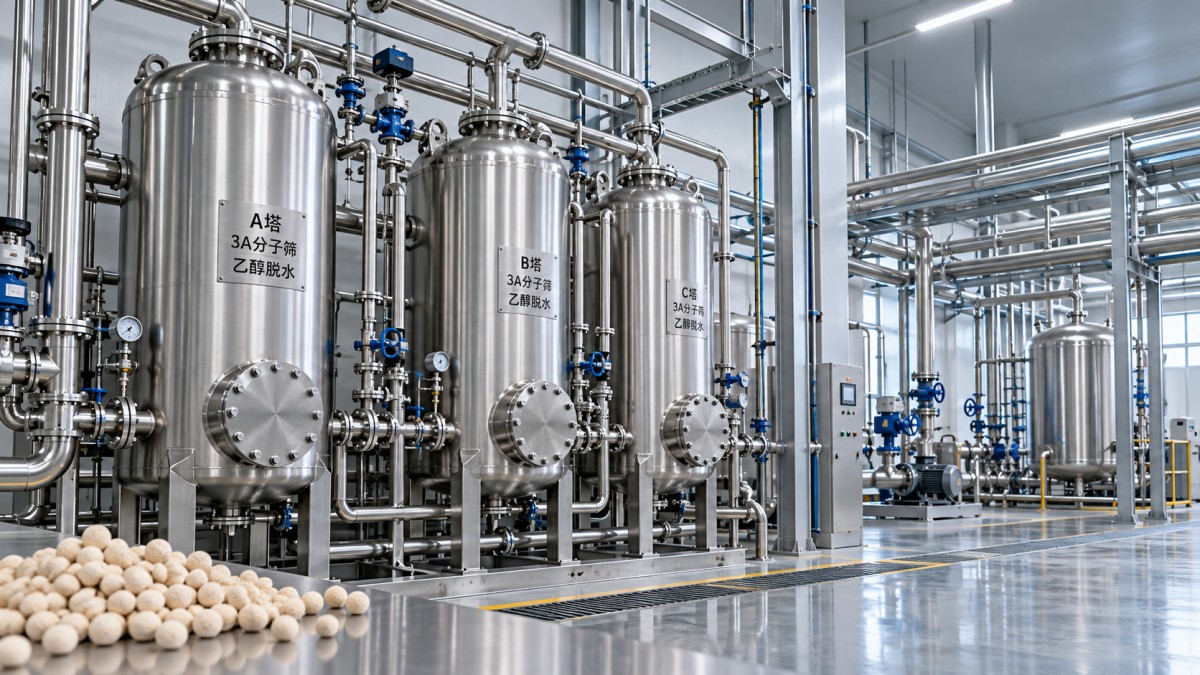
Molecular sieve 3A removes water from ethanol through selective adsorption. Water enters the zeolite’s small pore openings and binds to internal adsorption sites, while ethanol is largely excluded.
This distinction matters because ethanol itself is the valuable product. An adsorbent that takes up substantial ethanol can increase product losses, regeneration energy, and solvent handling requirements.
In a properly designed system, the sieve can reduce residual water to levels that ordinary distillation cannot economically achieve on its own. The achievable specification depends on the complete process.
For evaluators, the central advantage is therefore selective access, not simply a high stated water capacity. The material must perform under the actual feed composition and operating cycle.
Common industrial systems use alternating beds: one dries ethanol while another is regenerated or cooled. This arrangement can provide continuous product flow when switching and regeneration are correctly controlled.
A successful evaluation should compare the sieve’s water removal, ethanol losses, pressure drop, cycle stability, and regeneration demand against the required product specification and operating costs.
How does 3A separate water from ethanol?
Molecular sieve 3A is a synthetic aluminosilicate zeolite, commonly produced by exchanging potassium ions into a type A framework. These ions reduce the effective pore opening.
The designation “3A” refers to an approximate pore opening of three angstroms, not a precisely rigid physical aperture. Actual molecular transport also depends on temperature and material formulation.
Water molecules are small enough to enter the accessible pore network readily. Their polarity also promotes strong interactions with adsorption sites inside the zeolite structure.
Ethanol molecules are larger and encounter a substantial size-exclusion barrier. Consequently, an appropriately selected 3A grade preferentially adsorbs water instead of allowing significant ethanol uptake inside its pores.
Exclusion should not be interpreted as zero ethanol retention. Ethanol can remain in void spaces between beads, adhere to external surfaces, or be carried out during regeneration.
Commercial sieves also contain binders, and their performance varies with manufacturing and operating conditions. Supplier data and representative testing are more reliable than pore-size claims alone.
Adsorption is exothermic: as water is captured, the bed releases heat. That heat affects local equilibrium and mass transfer, making temperature profiles important during design and operation.
The water-loading zone moves through the bed over time. When it approaches the outlet, water concentration rises and the bed must be switched before product exceeds its specification.
Why is an adsorbent needed after distillation?
At atmospheric pressure, ethanol and water form an azeotrope near 95.6% ethanol by mass. Near that composition, conventional distillation cannot produce substantially drier ethanol by further ordinary rectification.
The precise azeotropic composition changes with pressure, and process design may exploit that behavior. Nevertheless, reaching stringent water limits typically requires an additional separation step.
Molecular sieve dehydration complements distillation by selectively removing the remaining water. The distillation section handles most of the bulk separation; the adsorption section provides final drying.
Alternative routes include extractive distillation, pressure-swing distillation, pervaporation, and other membrane processes. Their relative economics depend on scale, utilities, feed quality, and available equipment.
A molecular sieve is not automatically the lowest-cost option. It is attractive when reliable low water content, established operating practice, and integration with existing distillation are priorities.
For a technical comparison, define the same feed basis and final water specification for every option. Include utilities, product recovery, capital, maintenance, and disposal across the expected service life.
Vapor or liquid dehydration: which process is suitable?
In vapor-phase dehydration, ethanol-rich vapor passes through the sieve bed. Many fuel-ethanol facilities integrate vapor adsorption with distillation and use pressure changes to support regeneration.
Vapor operation can avoid condensing and revaporizing the entire feed between distillation and adsorption. Its energy benefit depends on plant heat integration and pressure levels.
Liquid-phase dehydration passes ethanol through a packed bed as a liquid. It may suit applications where the feed is already liquid and heating the entire stream is undesirable.
Liquid systems still require careful regeneration, cooling, and management of retained solvent. Liquid holdup can be an important source of ethanol loss and operating complexity.
Vapor and liquid systems differ in mass transfer, pressure drop, thermal behavior, and equipment design. Capacity figures from one phase should not be applied directly to the other.
Before choosing a configuration, establish feed phase, pressure, temperature, flow variability, required uptime, and available utilities. Then request performance predictions for those specific conditions.
Laboratory results can screen candidates, but a pilot test or validated supplier model is particularly valuable when feed impurities, unusually low water limits, or frequent cycling are involved.
What water specification does the process actually need?
Start with the maximum permitted water content in the finished ethanol and the analytical method used to verify it. A specification is useful only when the measurement basis is clear.
Water limits may be expressed as mass percent, parts per million by mass, or volume-based concentrations. Confirm conversions using the actual product composition and applicable density.
For example, 0.1% water by mass equals 1,000 ppm by mass. This conversion does not establish whether that limit is suitable for a particular application.
Different uses, including fuel, chemical synthesis, pharmaceuticals, and laboratory applications, may have different specifications. Contract terms and applicable standards must be checked for the intended market.
For very dry product, the sampling system matters. Atmospheric moisture, wet sample containers, leaking fittings, and delays before analysis can make the measured water content misleading.
Karl Fischer titration is commonly used for water determination in ethanol. Select and validate the appropriate method, sampling procedure, calibration, and quality controls for the expected concentration.
Set an operating target below the contractual limit to account for measurement uncertainty, normal process variation, and breakthrough detection. The appropriate margin should be established from plant data.
How much water can molecular sieve 3A remove?
Published water capacity is usually measured under specified laboratory conditions. It represents neither a guaranteed plant loading nor the amount available during every adsorption cycle.
Equilibrium capacity depends on water activity, temperature, and the surrounding fluid. A bed approaching a very low outlet concentration operates under different conditions from a humid-air test.
Working capacity is the difference between the water loading at the end of adsorption and the residual loading after regeneration. It is the more useful starting point for cycle sizing.
Even working capacity must be qualified by flow rate and outlet specification. A bed can contain unused adsorption capacity when the first portion of the bed reaches breakthrough.
As an illustrative calculation, a feed of 1,000 kilograms per hour containing 5% water by mass carries 50 kilograms of water per hour before dehydration.
If the dry product is close to 0.1% water by mass and ethanol losses are neglected, approximately 49 kilograms of water must be removed each hour.
If a validated cycle provides 10% usable working capacity by adsorbent mass, roughly 490 kilograms of active sieve would theoretically hold one hour’s water load.
This is a mass-balance illustration, not a vessel design. Real sizing must include breakthrough behavior, incomplete regeneration, aging, distribution, downtime, and the actual product flow and composition.
Do not substitute a supplier’s humid-air equilibrium capacity into that calculation without justification. Request ethanol-specific breakthrough curves or cycle data at representative feed and regeneration conditions.
What operating conditions influence breakthrough?
Inlet water concentration directly affects cycle length. A wetter feed increases the water load, generally shortening the time before the outlet reaches its permitted limit.
Temperature affects both equilibrium and kinetics. Higher temperatures can reduce water adsorption equilibrium, while temperature changes also alter transport rates and vapor-liquid behavior.
Pressure affects vapor density, residence time, and the partial pressures of water and ethanol. Pressure changes may also influence regeneration performance in pressure-swing systems.
Flow rate determines how quickly water reaches the bed and how long the fluid contacts the adsorbent. Excessive throughput can cause early breakthrough even when theoretical capacity remains.
Bed depth affects the space available for the mass-transfer zone. A shallow bed may provide insufficient separation distance, especially when the required outlet water concentration is very low.
Feed distribution matters as much as total bed volume. Channeling, poor inlet design, settling, or damaged support screens can allow wet fluid to bypass useful adsorbent.
Particle size creates a tradeoff. Smaller beads can improve mass transfer but typically increase pressure drop and sensitivity to fines; larger beads may require more bed depth.
Track outlet water, bed temperatures, differential pressure, flow, and switching times together. A change in one signal is easier to diagnose when the others are available.
Inlet upsets should trigger a defined response, such as shortening the cycle, diverting off-specification product, or reducing throughput. The response depends on the plant’s control philosophy.
How are saturated sieve beds regenerated?
Regeneration removes adsorbed water so the sieve can be reused. Industrial systems may use heat, reduced pressure, a dry purge stream, or a combination of these methods.
In a temperature-swing process, heating reduces water affinity and drives desorption. The bed must then cool sufficiently before returning to service, adding time to the cycle.
In a pressure-swing process, lowering pressure reduces water partial pressure and encourages desorption. A dry purge may assist removal, depending on the process configuration.
Some systems use a portion of dry ethanol vapor as purge. The resulting regeneration stream can contain water and ethanol, requiring appropriate recovery or treatment.
Regeneration effectiveness depends on temperature, pressure, purge composition, flow, and duration. A short cycle saves time only if it leaves sufficiently low residual water loading.
Insufficient regeneration gradually reduces working capacity and can cause earlier breakthrough. Excessive heating, meanwhile, consumes energy and may damage the adsorbent, vessel internals, or seals.
Use the adsorbent supplier’s temperature limits and the equipment designer’s procedures. There is no universal regeneration temperature or duration suitable for every 3A product and ethanol process.
Verify regeneration by monitoring performance over repeated cycles, rather than relying solely on heater outlet temperature. Bed temperature profiles and subsequent breakthrough times provide useful evidence.
Include heating, cooling, purge consumption, vacuum or compression, and ethanol recovery in the energy balance. These costs can outweigh a modest difference in purchase price.
How does 3A compare with 4A and other drying options?
Molecular sieve 4A has a larger nominal pore opening than 3A. That difference can allow greater interaction with ethanol, increasing the risk of solvent co-adsorption.
For ethanol drying, 3A is generally preferred when selective water removal and limited ethanol uptake are important. Actual losses still depend on formulation, phase, and process conditions.
Larger-pore sieves, such as 5A and 13X, can admit a wider range of molecules. They should not be substituted solely because their water-capacity datasheets look attractive.
Activated alumina, silica gel, membranes, and other desiccants may be useful in specific processes. Each has different selectivity, regeneration requirements, impurity sensitivity, and achievable product dryness.
Compare options using consistent test conditions: identical feed, target water limit, flow rate, cycle duration, and regeneration assumptions. Otherwise, nominal capacity comparisons can be misleading.
For processes requiring exceptionally low water content or sensitive downstream chemistry, also assess extractables, dust, contamination, and material compatibility, not just the final moisture number.
Which feed contaminants can reduce performance?
Feed composition can affect a sieve even when ethanol and water are the principal components. Trace contaminants may compete for sites, form deposits, or damage the bed.
Suspended solids can plug distributors, foul bead surfaces, and increase pressure drop. Appropriate upstream filtration and clean commissioning procedures help limit these problems.
Oils, heavy organics, degradation products, or residues can impair mass transfer or block accessible pores. Their impact depends on molecular size, concentration, temperature, and regeneration conditions.
Acidic or alkaline contaminants may affect zeolite stability or associated equipment. Evaluate their concentrations against the supplier’s compatibility guidance and the materials of construction.
Unexpected changes in feed can shorten cycles before laboratory tests reveal the cause. Retain feed-quality records alongside operating data so performance changes can be investigated.
When impurities are unavoidable, test the actual mixture over repeated cycles. A clean ethanol-water laboratory mixture may not predict long-term behavior in a production stream.
What should evaluators request from a supplier?
Ask for the exact product grade, particle size distribution, bulk density, crushing strength, attrition method, and recommended service conditions. Request test methods alongside each reported value.
Obtain adsorption and breakthrough data relevant to ethanol dehydration, preferably using similar feed composition, phase, temperature, pressure, and outlet water limits.
Request regeneration guidance covering maximum temperature, purge requirements, expected cooling time, and any restrictions on heating or pressure change rates.
Clarify whether reported capacity is equilibrium or cyclic working capacity, and identify the water activity, temperature, sample preparation, and test duration behind the figure.
Ask how the supplier characterizes ethanol retention and losses. Distinguish adsorption inside the material from solvent held between particles or carried with the regeneration stream.
Confirm packaging integrity, residual moisture on delivery, storage life, and handling instructions. An exposed bag can absorb atmospheric moisture before the material reaches the vessel.
For regulated applications, obtain relevant documentation on composition, trace impurities, change control, and suitability for the intended use. A technical datasheet alone does not establish regulatory compliance.
Finally, request a basis for expected service life and replacement criteria. Lifetime depends on feed cleanliness, thermal history, cycling, handling, and the plant’s acceptable performance decline.
How should the bed be operated and monitored?
Keep unopened adsorbent in its original moisture-tight packaging until loading. Minimize exposure during transfer and follow site procedures for dry equipment and controlled handling.
Inspect supports, screens, distributors, and vessel cleanliness before filling. Incorrect loading can create segregation or voids that undermine performance regardless of adsorbent quality.
Establish a commissioning baseline for differential pressure, cycle length, outlet water, regeneration conditions, and ethanol recovery. Compare subsequent results with that baseline under similar feed conditions.
Set switching logic with a margin before the product water limit is reached. Online analyzers can support control, but their calibration and response time must be understood.
Rising differential pressure may indicate fines, fouling, or liquid accumulation. A shorter cycle may indicate higher inlet water, incomplete regeneration, channeling, contamination, or material deterioration.
Investigate trends before replacing the sieve. A failed valve, wet purge, analyzer drift, or changed feed can produce symptoms that resemble adsorbent exhaustion.
Confirm that standby beds are isolated and regenerated as intended. Poor valve sequencing can contaminate dry product or send wet regeneration gas into the wrong section.
What safety and economic risks require attention?
Ethanol is flammable, and its vapors can form hazardous mixtures with air. Equipment design must address ignition sources, hazardous-area classification, ventilation, and applicable local requirements.
Regeneration and vessel maintenance introduce additional hazards, including hot surfaces, pressure changes, solvent release, and possible oxygen displacement when inert gas is used.
Follow a site-specific hazard analysis and written isolation procedures. Gas testing, pressure relief, grounding, and confined-space controls should reflect the actual equipment and operating scenario.
Water adsorption releases heat, and unexpected feed changes can create temperature excursions. Assess thermal effects and instrumentation during design rather than treating the bed as an inert vessel.
Evaluate cost per unit of on-specification ethanol, not simply cost per kilogram of adsorbent. Include energy, purge, solvent recovery, downtime, labor, and replacement.
A grade with lower purchase price may still be more expensive if it causes shorter cycles, higher pressure drop, more fines, or greater regeneration demand.
Conversely, a higher nominal capacity has limited value if it cannot be realized at the required product water concentration or within the available regeneration time.
Use a representative operating case and sensitivity analysis for feed water, energy prices, uptime, and sieve life. This makes competing supplier proposals easier to compare.
Conclusion: when is 3A the right choice?
Molecular sieve 3A is a strong candidate when ethanol must be dried beyond ordinary distillation limits and selective water removal is essential to product recovery.
Its value comes from the combination of water-accessible pores, limited ethanol uptake, and a regenerable adsorption cycle. None of those properties eliminates the need for process-specific validation.
Prioritize demonstrated working capacity, breakthrough behavior, regeneration energy, mechanical durability, and feed compatibility. Confirm that the complete system can consistently meet the specified water limit.
For a separate application, Insulating Glass Molecular Sieve is intended for sealed glazing spacers, with bead sizes of 1.0–2.0 or 1.5–2.5 mm.
That glazing material addresses cavity moisture and is not presented as an ethanol-dehydration grade. Confirm product formulation and application suitability with the supplier before considering any substitution.
Can't find what you're looking for ?
Leave a Message we will call you back quickly!
Get in Touch
*We respect your confidentiality and all information are protected.